


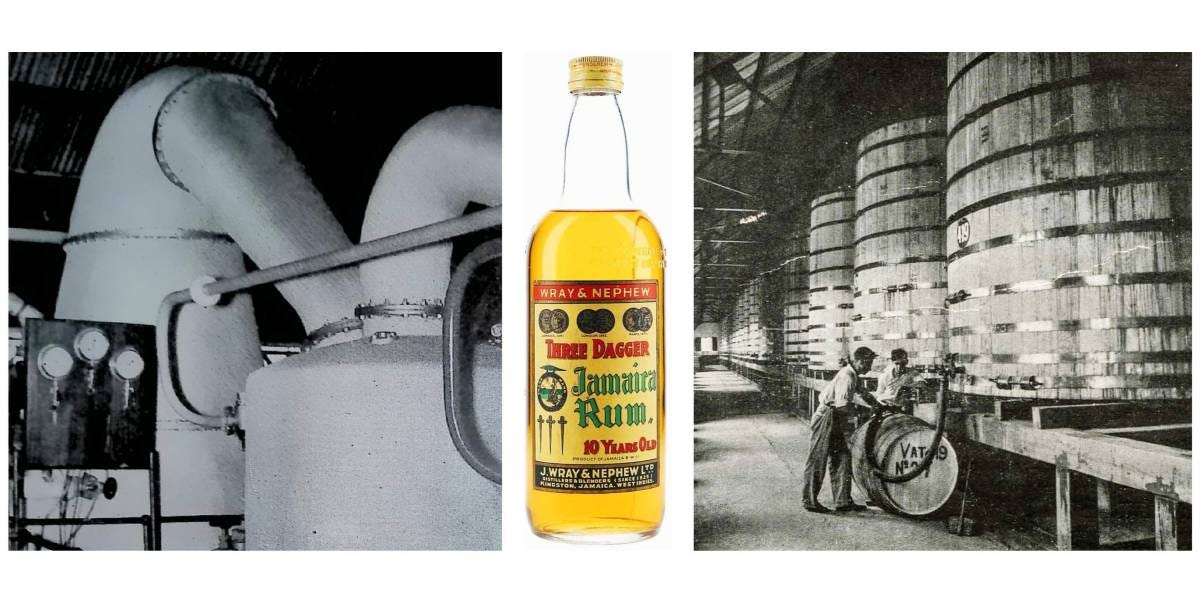
How cool would it be to step back in time to visit Jamaica’s Appleton Estate in 1950? While time machines are still a way off, a Wray & Nephew brochure from the era and other archival photos provide a surprisingly detailed look at the company’s rum making 75 years ago.
The brochure is titled “The Story of Dagger Jamaica Rum.” While undated, the images and styling suggest an early 1950s publishing date. Within its 32 pages, numerous black-and-white images and textual descriptions take us on a journey from the cane fields to the bottling line. Let’s “step inside” the brochure and mentally transport ourselves to 1950s Jamaica.
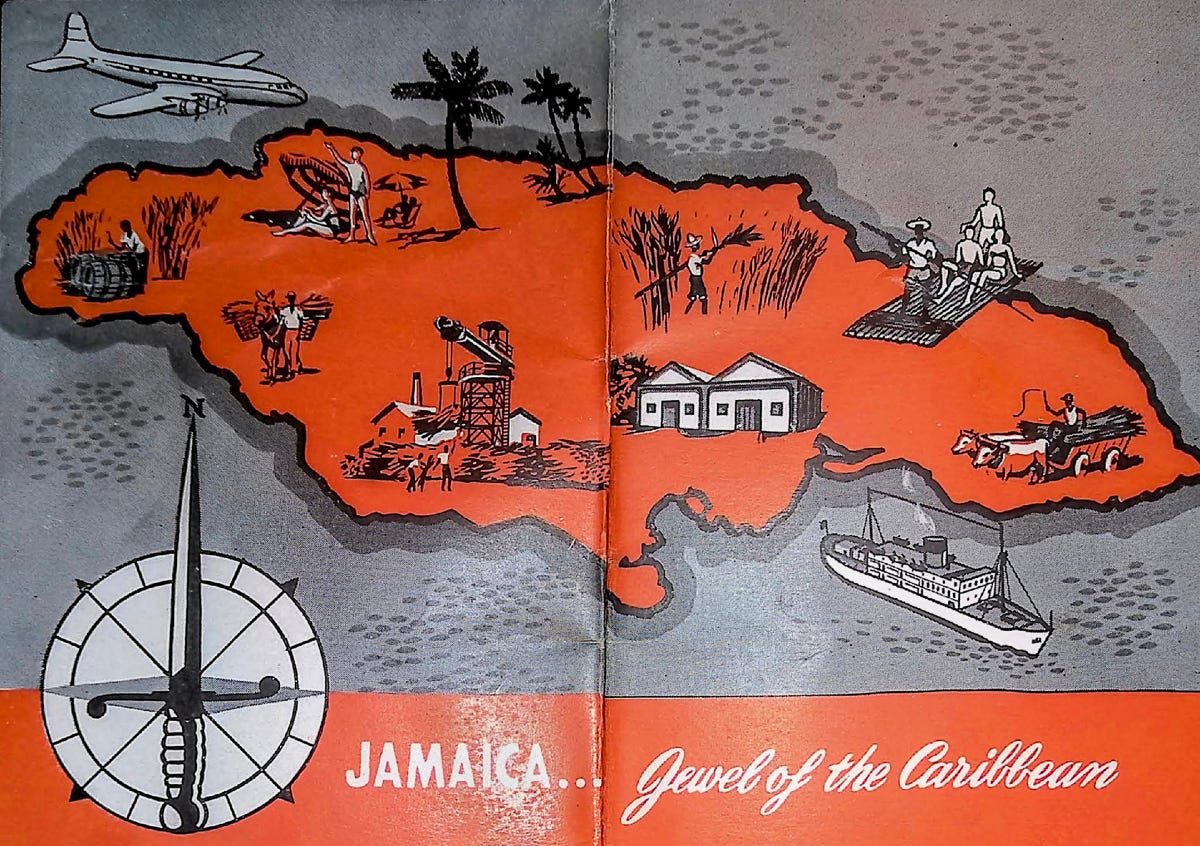
Setting the Stage
Jamaica is still a British colony in 1950, but it is rapidly acquiring modern amenities. The arrival of affordable air travel in the post-WWII era boosted its popularity as a tourist destination. Wray & Nephew is owned by Percy Lindo, of Lindo Brothers fame, though within a decade, he would sell the company to Lascelles DeMercado and the Henriques Brothers.
Wray & Nephew’s distillery, Appleton Estate, is an integrated sugar mill and rum making operation at the time. Unfortunately, the subsequent steep decline in Caribbean sugar economics would shutter many sugar mills, leaving distilleries such as Appleton separated from the factories that once supplied their molasses.
Pot distillation was the only game in town for Jamaican rum making in 1950. It would be another decade before column distillation gained a foothold in Jamaica’s rum distilleries.
In a nod to practicality and the export market, Wray & Nephew’s aging bonds and bottling operations are 60 miles east of Appleton Estate in Kingston. So large is Wray & Nephew’s aging stock that the company owns four massive aging warehouses for its rum to slumber under the eye of Jamaica’s excise officials.
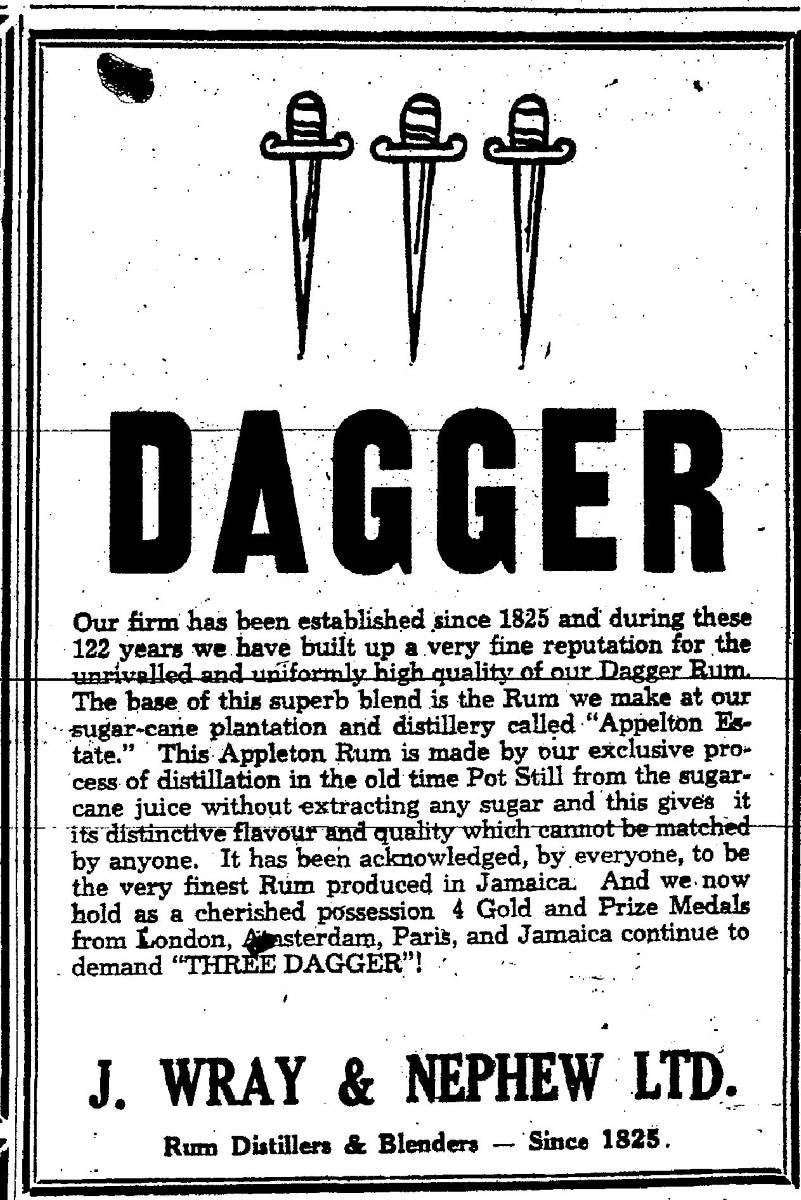
Wray & Nephew has over a dozen rums in its portfolio, but it’s the Dagger line (One, Two, and Three Dagger) that’s most heavily promoted. Appleton Estate Special had launched less than a decade earlier, but hadn’t yet acquired the prestige of Appleton Estate rum today.
In what follows, I will mix quotes from the aforementioned brochure, photographs, and my own editorial comments. My notes are in regular text like this, while….
Text sections formatted like this are taken directly from the brochure.
The Tour Begins – Sugarcane Mill
Our tour begins with a long drive out to Cockpit Country, where Appleton Estate sits alongside the Black River. Sugarcane fields extend in all directions. The air is hot, and the noise from the sugar factory makes it hard to hear.
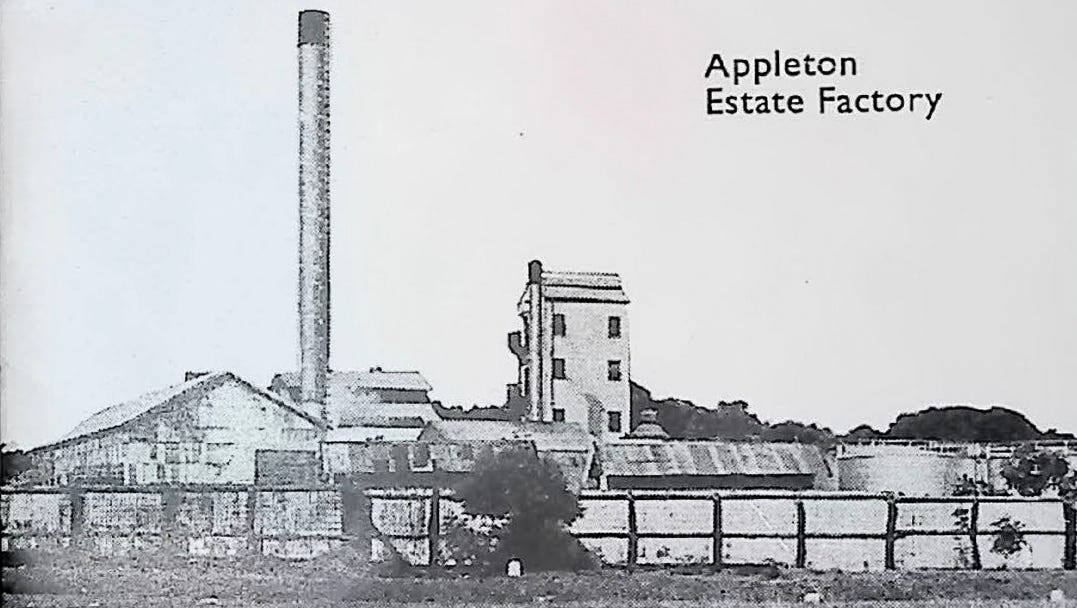
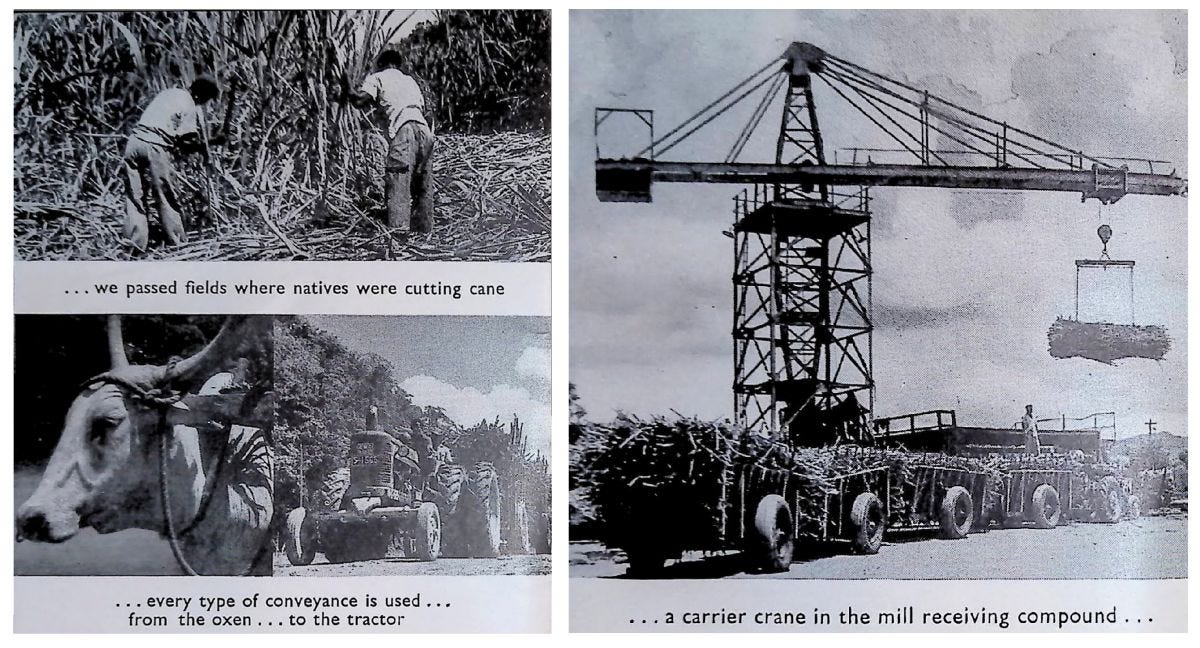
The cane must arrive at the sugar mill as soon after cutting as possible. All manner of conveyances are used from ox-wagon to the motor tractor, truck, and the special narrow gauge railway…. What’s that across the road? … a crane that lifts whole cart loads of sugar cane to the conveyor.
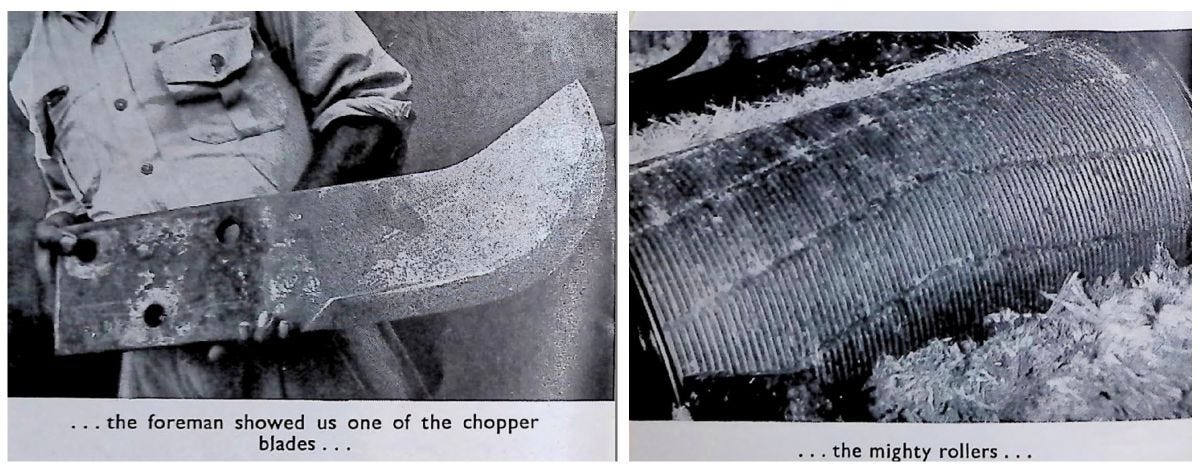
Up the conveyor belt it goes to the “chopper”— a series of heavy sharp knives on a whirling shaft…. The “crusher” operates just like the family clothes wringer; the rollers are made of hard steel, with peculiarly patterned indentations—the diameter about 26 inches. Here is where the last drop of cane juice is squeezed out…
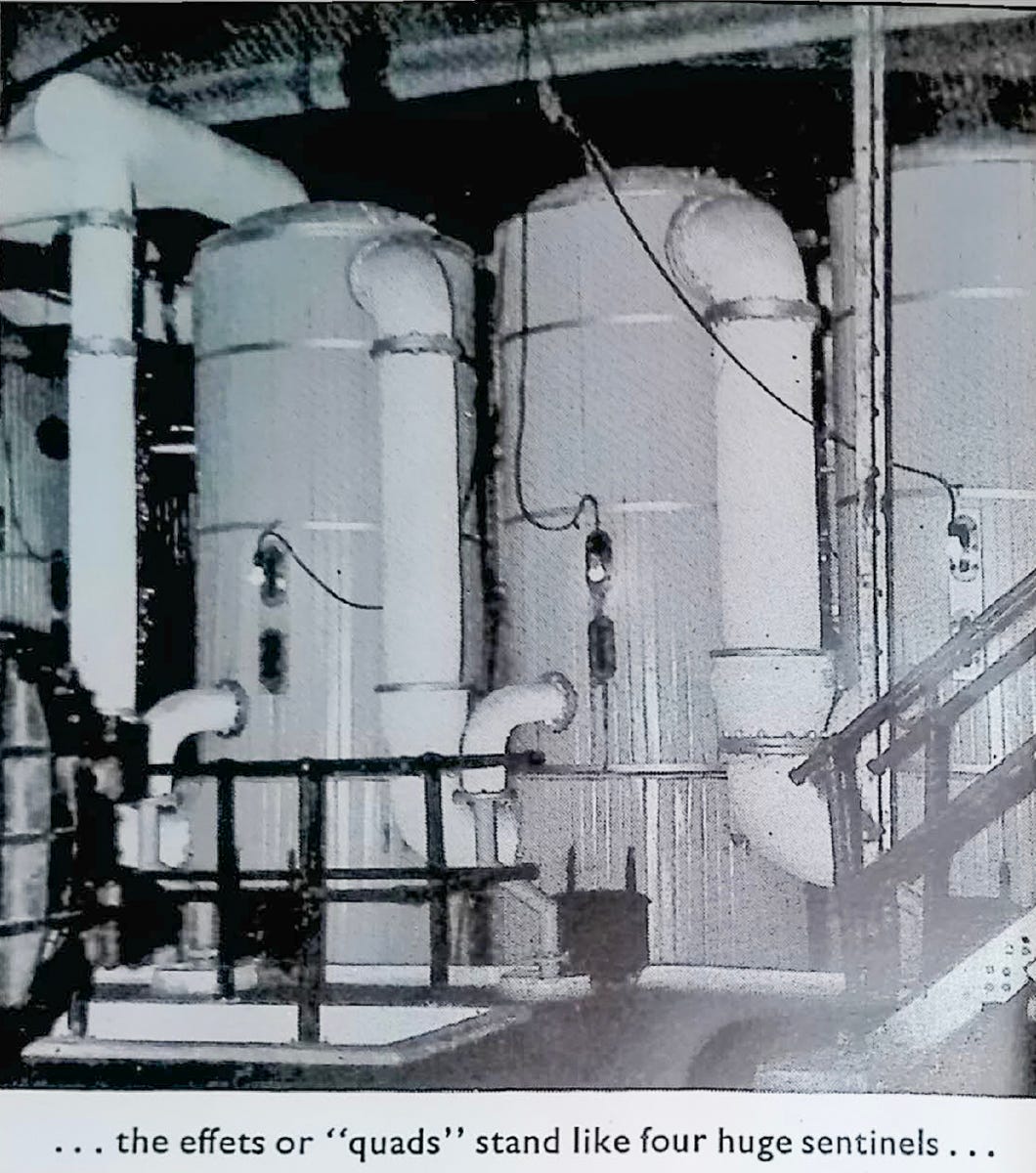
From there the juice passes on to the evaporator station for 75% of the water to be boiled off… But it is the job of the “vacuum pans” to boil off the balance of the water, thereby crystallizing the syrup of the original cane juice, to make sugar. These crystals, however, are floating around in the glucose content which we call molasses.
Fermentation
Sugar factory tour complete, we now walk 50 meters to the adjoining distillery complex and enter the fermentation hall.
The first step in making rum is the mixing of molasses and water together in a large tank. The result is called “wash.” We tried to get the recipe but the proportions are one of the Distillery’s secrets—a secret that provides Dagger Rum with its characteristic fineness and inimitable flavour.
Nothing surprising here. However… if we go reread the 1947 Dagger advertisement shown earlier, it says, “This Appleton Rum is made by … the sugarcane juice without ‘extracting any sugar and this gives it its distinctive flavour….”
At first glance, this mention of sugarcane juice is very surprising! Was Appleton really making rhum agricole? Not necessarily. The sugarcane juice mentioned may be concentrated cane juice, that is, cane syrup. A cane syrup fermentation yields a flavor closer to a molasses fermentation than a raw cane juice fermentation.
But again, the brochure says molasses. Maybe we can blame marketing copy, which isn’t always so great at conveying these small but important details. In any event, it’s an interesting detail to file away for future investigation.
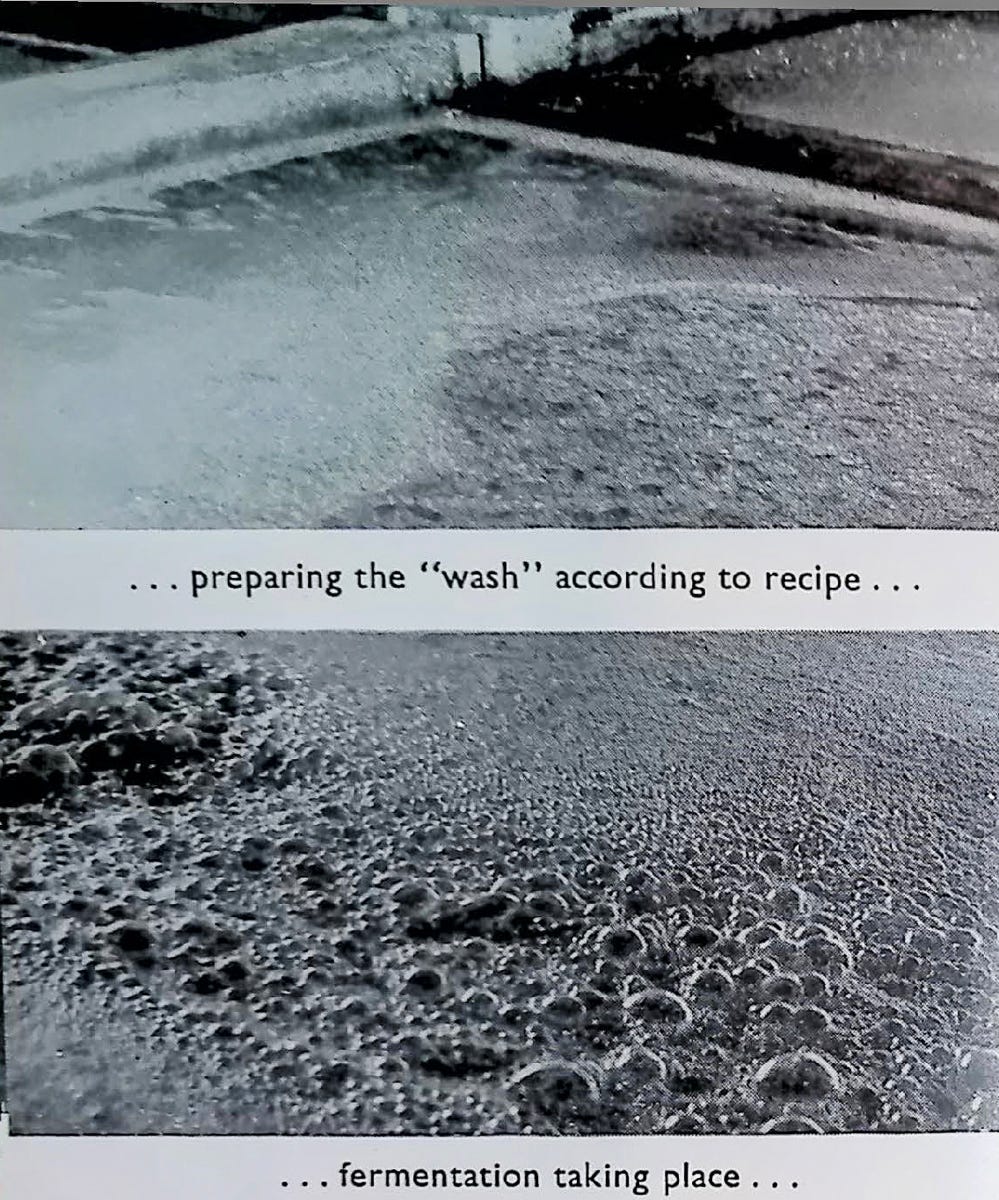
The “wash” is pumped into a series of fermenting vats, each vat holding 4,400 gallons. In these large vats fermentation takes place for about 72 hours. At the end of this time fermentation ceases. The “wash” is now ready for distillation.
The 72-hour fermentation is dwelling on for a bit. It’s typical duration for a mainstream rum, but the truly bold, funky flavors Jamaican rum is famous for come from much longer fermentations, à la Hampden and Long Pond.
Just like today, Jamaican rum of the mid-20th century had a wide spectrum of flavor intensities. While we’d like to imagine that old-school Wray & Nephew rums were funk bombs, historical evidence and tastings of old W&N samples suggest otherwise. Vive la difference!
Distillation
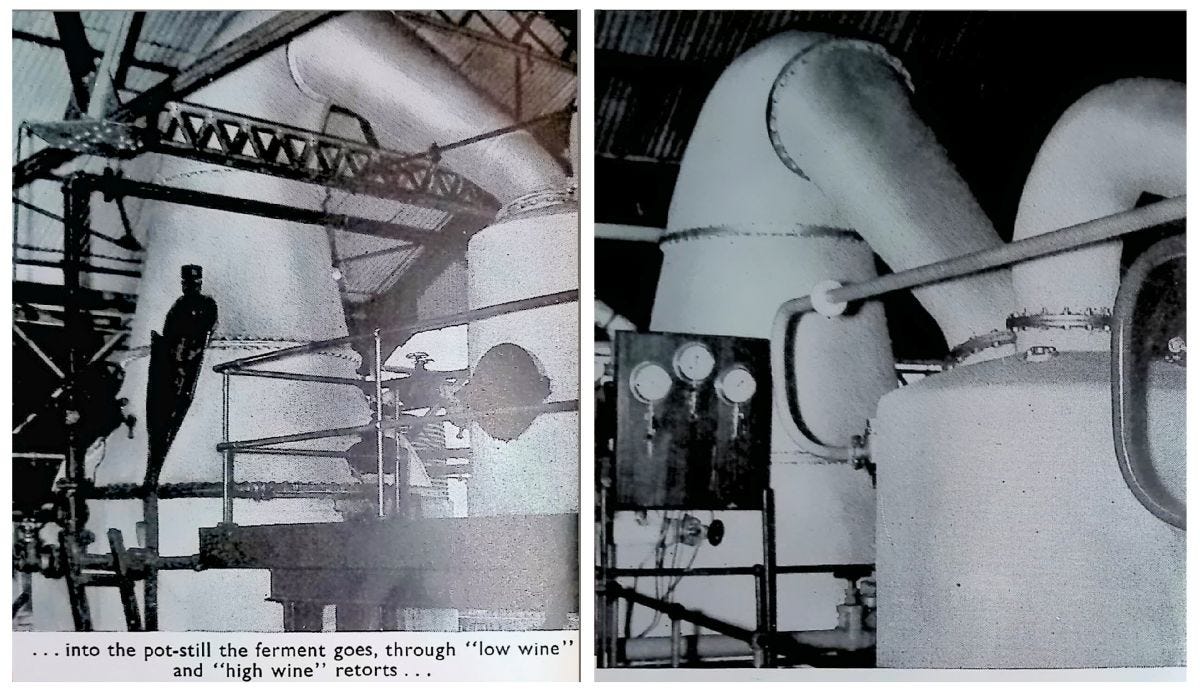
A “charge” of from 1,200 to 2,000 gallons of fermented “wash” is run into the pot-still. Vapours form, which pass through a “low wine” and a “high wine” retort. It is in these two retorts that the vapours pick up the bouquet and flavour that distinguishes Jamaica Rum. The vapours are then condensed into a crystal clear liquid which bubbles forth from the still as new Jamaica Rum.
While the pictures above unfortunately don’t show the entire still, the reference to low wine and high wine retorts makes it clear that Appleton was using double retort pot stills. A single distillation pass goes through three distinct enrichment phases and yields rum at 80% ABV or higher. Double retort stills are almost synonymous with Caribbean rum making, and Jamaican rum in particular.
The size of the wash batches enables us to infer the pot still sizes, so likely Appleton had a set of stills between 1,200 and 2,000 gallons. A decade or two later, Appleton’s “pot still row” would be upgraded to 5 double-retort stills, each 5,000 gallons in size.
Aging, Blending, and Bottling
With our visit to Appleton Estate complete, it’s time to hitch a ride back to Kingston in the cab of one of the many Wray & Nephew rum tanker trucks headed that way. Our first stop is an aging warehouse.
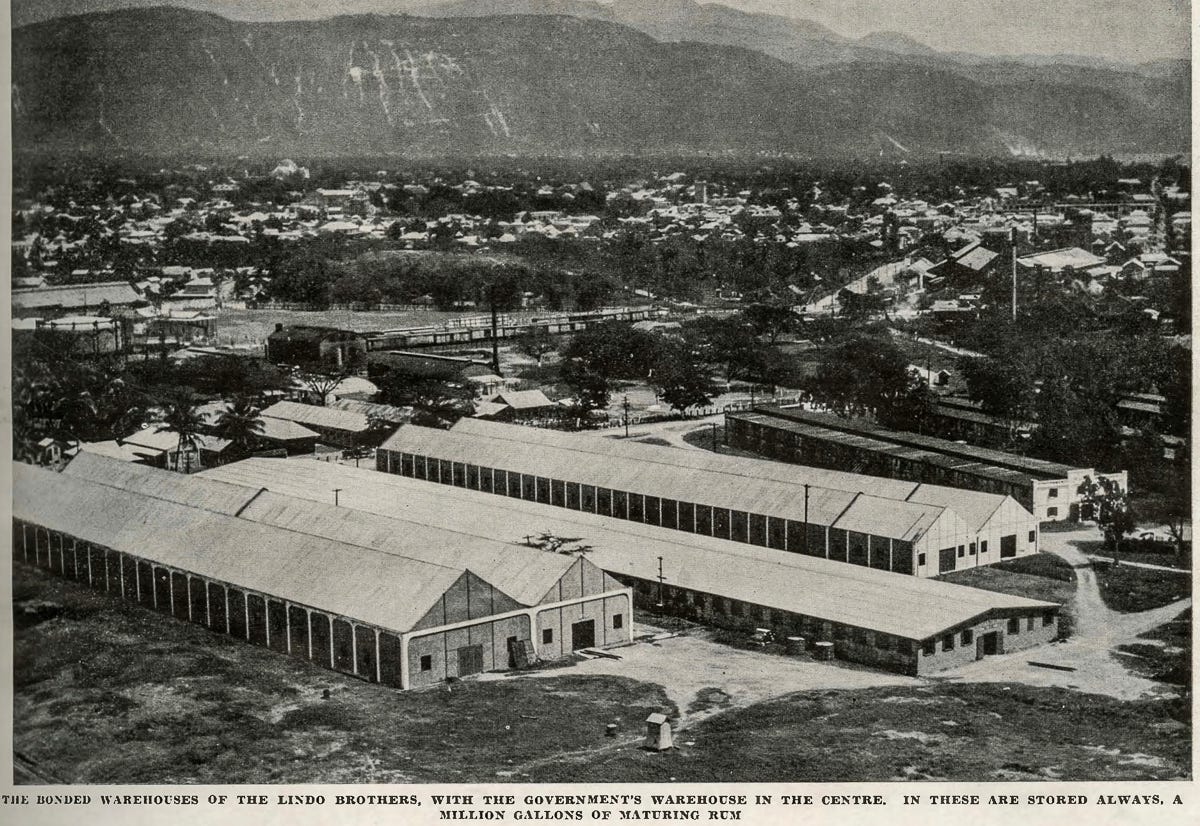
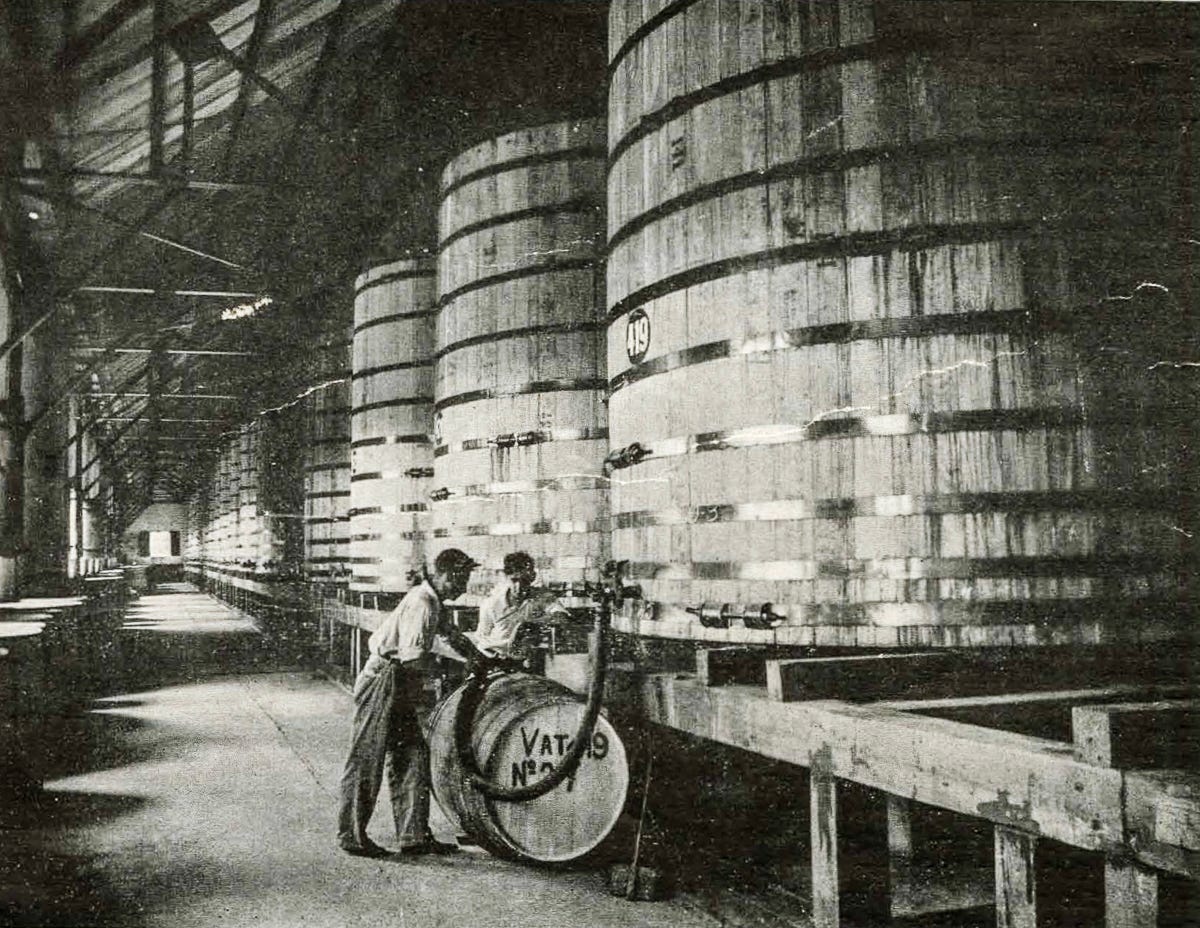
Over two million gallons of Dagger Rum rest in casks, and in five and ten thousand gallon oaken vats. These are stored in four large bonded Government warehouses that were built privately by J. Wray & Nephew Ltd., exclusively for ageing their Dagger Rums.
Of interest here is aging in five- and ten-thousand-gallon vats, i.e., “vatted rum.” The practice was quite common at the time, allowing rum to mellow over long durations without becoming overly oaky. However, there’s a school of thought today that age statements shouldn’t apply to vat-aged rum. Aging in small casks has become the norm.
Also of note, the image of vats above was previously used in a 1938 story about the company, stating that it had a million gallons aging. Roughly a decade later, Wray & Nephew had double that amount, a significant expansion despite the interruption of World War II.
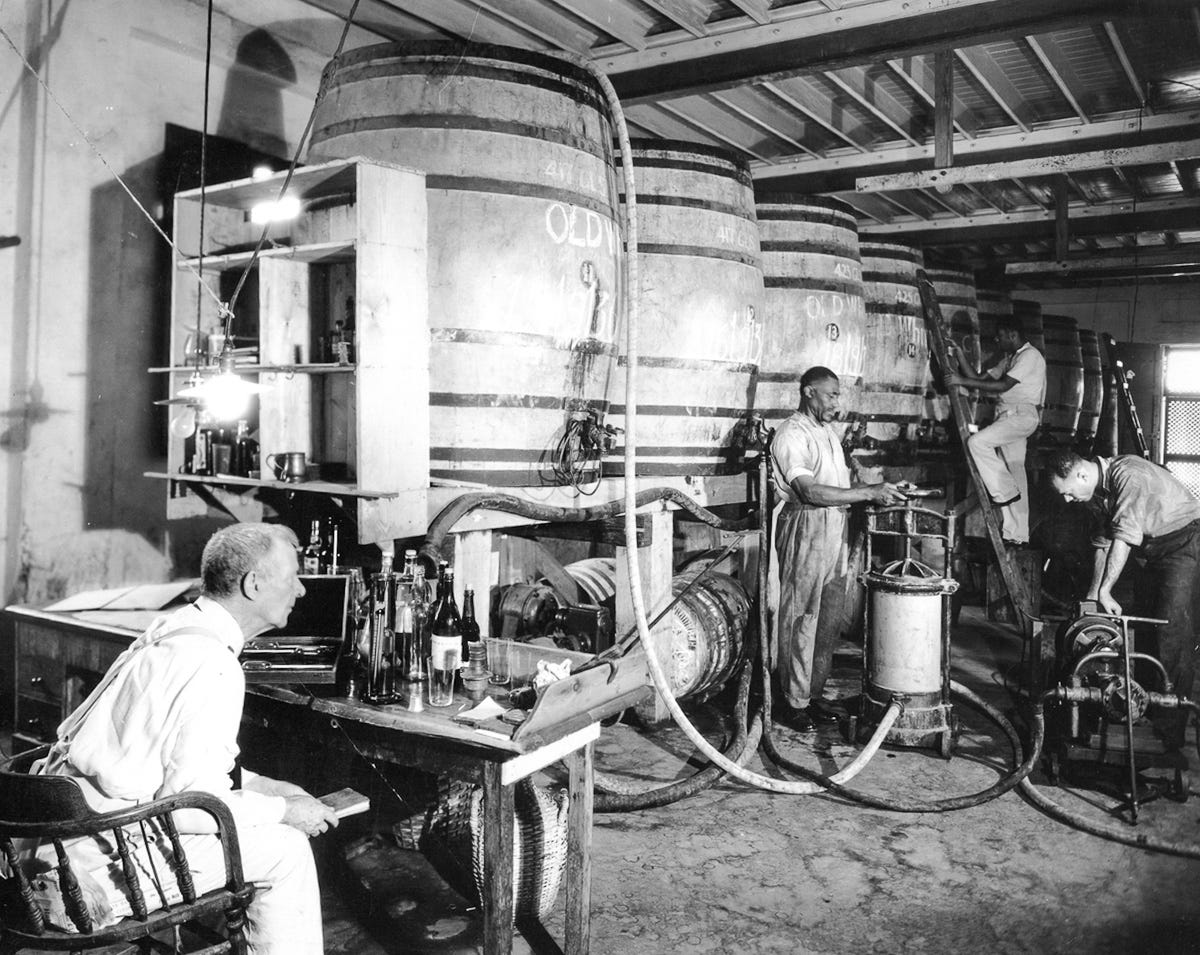
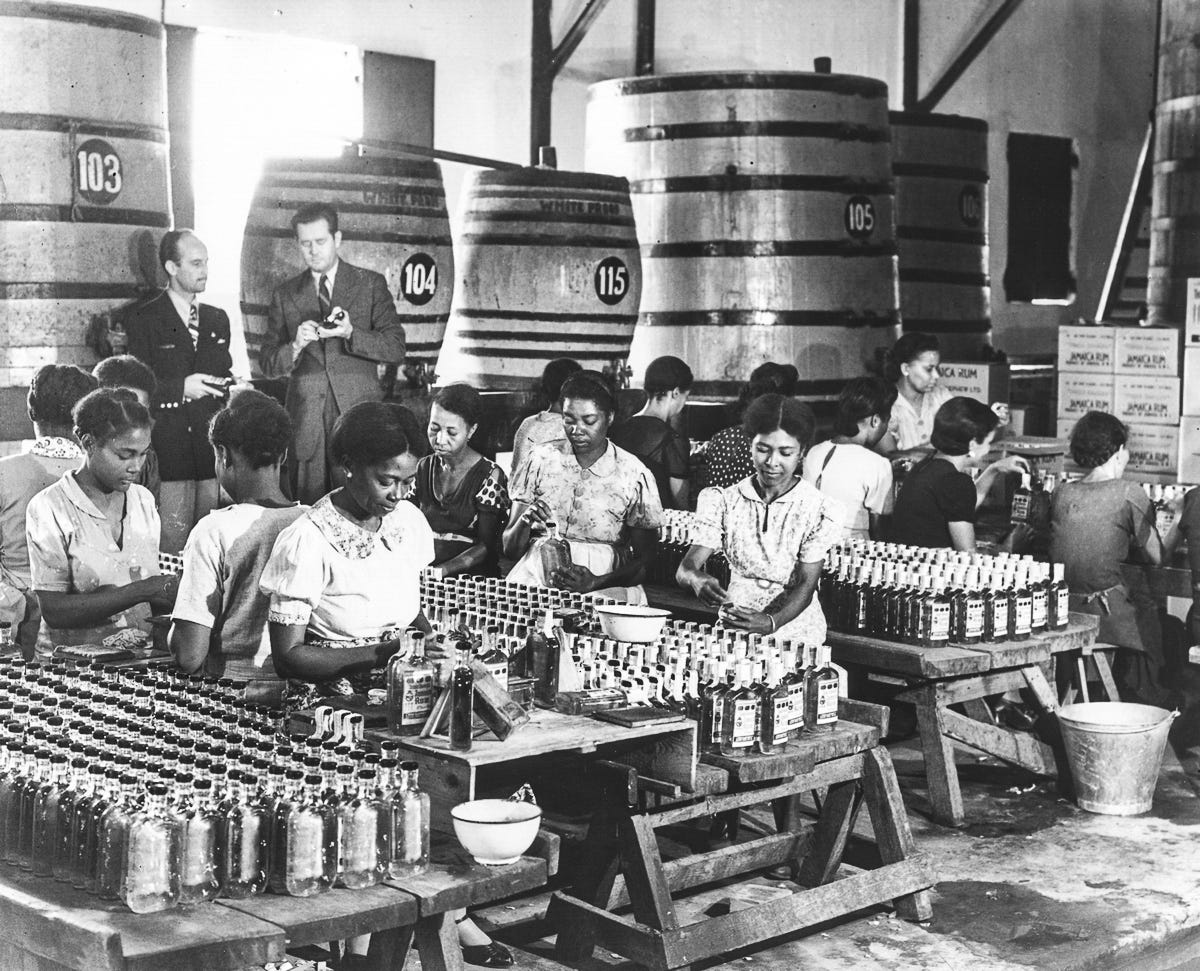
While not shown in the brochure tour, fellow historian Tim Glazner has given me the OK to include two photos from the early-1940s photos that show blending and bottling operations. The first shows what appears to be filtering a batch of rum. The second shows workers applying labels to what appears to be “white proof” rum, a forerunner of Wray & Nephew White Overproof.
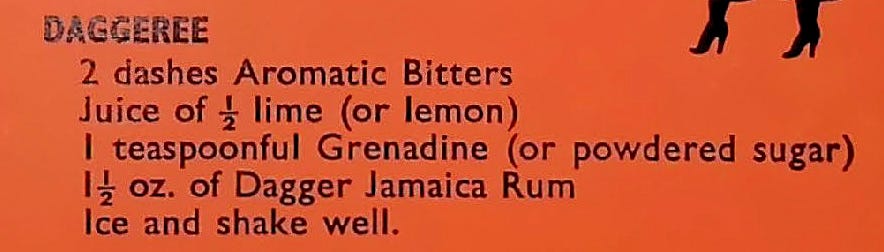
Tour completed, we reluctantly return to our time machine. But before boarding, we enjoy one final Daggeree cocktail.
I have ideas for a more photo-based tours from the past. Was this interesting? Let me know what you think in the comments!

Reading this article felt like stepping back into 1950s Jamaica. From the sugarcane fields to the distillation hall and even the aging warehouses in Kingston, the details are really vivid. Seeing the old pot stills and huge vats made me appreciate how traditional yet meticulous rum-making was back then.
Fascinating world of bygone days, bygone rums — please keep this up! Perhaps in another post you could explain the differences between Appleton rum and Meyers?