


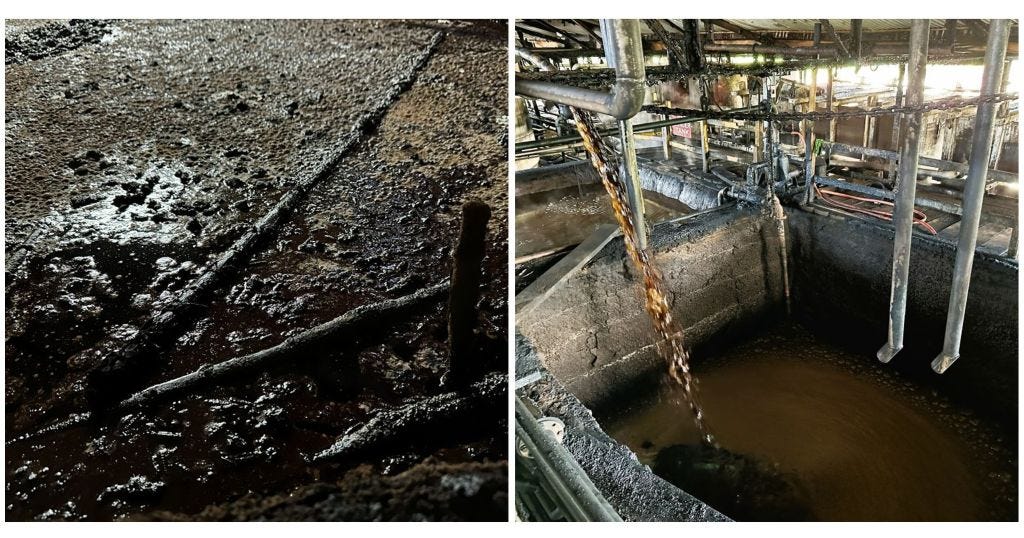
This is part two of a four-part deep dive into how funky, high-ester rums are created. There’s much more to it than just a particular yeast strain and a long fermentation.
Part 1 covers some baseline concepts that apply to all rum fermentation:
Yeast does much more than consume sugar and produce ethanol. It also produces trace amounts of other categories of molecules, including acids, higher alcohols, esters, and aldehydes. For the sake of convenience in what follows, we’ll call them congeners. Or if you prefer, call them flavor compounds.
The congeners created during fermentation are 99.9% responsible for the resulting aroma and flavor of unaged rum.
What differentiates the various congeners from each other is the arrangement and number of the atoms within the molecule. Each type of molecule, e.g., ethyl butyrate, has its own distinctive aroma and flavor.
Esters are formed when an alcohol molecule combines with an acid molecule.
The liquid remaining after fermentation completes is a “soup” of ethanol, water, and the flavor molecules described above.
There are many species and strains of yeast. Different yeast strains will create different soups, that is, different mixtures of flavor molecules.
A yeast’s surrounding environment, including temperature and pH level, alters the ratio and types of flavor molecules that a yeast strain creates.
The primary species of yeast used in rum fermentation is Saccharomyces cerevisiae, aka cerevisiae. The “underground punk rock” species of yeast is Schizosaccharomyces pombe, aka pombe.

In what follows, we’ll move beyond the usual yeast fermentation protocol that most rum makers use. While conventional fermentation can create flavorful rum, it can’t create the stratospheric levels of congeners exemplified by Jamaica’s “continental” rum styles and grand arôme rums made on Martinique and Réunion Island. For specific examples, see:
Hampden HLCF and DOK
and Savanna Lontan.
A brief editorial aside: while the phrase ‘high ester’ is commonly used in rum circles, ‘high congener’ is a more accurate description. Esters are just a subset of a rum’s congeners, and oftentimes, a surprisingly low percentage! In what follows, I shall use ‘high congener’ rather than ‘high ester’.

To achieve truly high congener levels, rum makers supercharge the fermentation process with additional ingredients that force the yeast to change the types and amounts of congeners it produces. Beyond just making more congeners, the resulting mix also contains congeners that a regular fermentation would have very little of.
Typical rum fermentations mostly make simple (“short-chain”) congeners. Supercharged fermentations contain much higher ratios of complex (“medium-chain”, “long-chain”) congeners. These medium- and long-chain flavor molecules give high-congener Jamaican rums, Grand Arôme rums, and other rums, such as River Antoine, their distinctive aromas and flavors.
You’re Stressing Me Out!
Much like humans act differently under stressful conditions, so do yeast cells. For yeast, stress (or lack thereof) is a function of various factors, including temperature, nutrient availability — they don’t live on sugar alone, pH level, and osmotic pressure. Vary these parameters during fermentation, and the yeast will adjust the amounts and ratios of the congeners it produces.
Here, I’ll limit the discussion to stress induced by low pH, or, in slightly less scientific terms, how acidic the fermenting mash is. If something acidic is added to the mash, both cerevisiae and pombe-type yeast will respond by producing more esters. Why so? By increasing the acid molecules in the mash soup, there’s more opportunity for yeast cells to combine the acid molecules with ethanol molecules (which the yeast makes) to create esters. Put another way, more acid gives yeast more ingredients to make more yummy esters, though the most complex congeners involve a different player we’ll meet later in the series.
However, cerevisiae strains are less resistant than pombe strains in more acidic environments (lower pH). A low pH level that might cause a pombe strain to break a sweat might immobilize or kill its cerevisiae strain cousin. For this reason, pombe yeast is much more prevalent in high-congener fermentations.
In short, the right yeast (pombe) plus additional acid in the mash recipe yields more esters. So, how do rum makers acidify their fermentation? We’re now ready to introduce dunder and cane acid into the discussion.
Dunder
Many misinformed books and articles have mythologized dunder as some sort of voodoo mystery ingredient. In reality, it’s just the waste liquid left over after distillation. When pot distilling, dunder is the liquid remaining in the kettle after the stripping run has finished. Column distillation also creates dunder, but that’s a different topic.
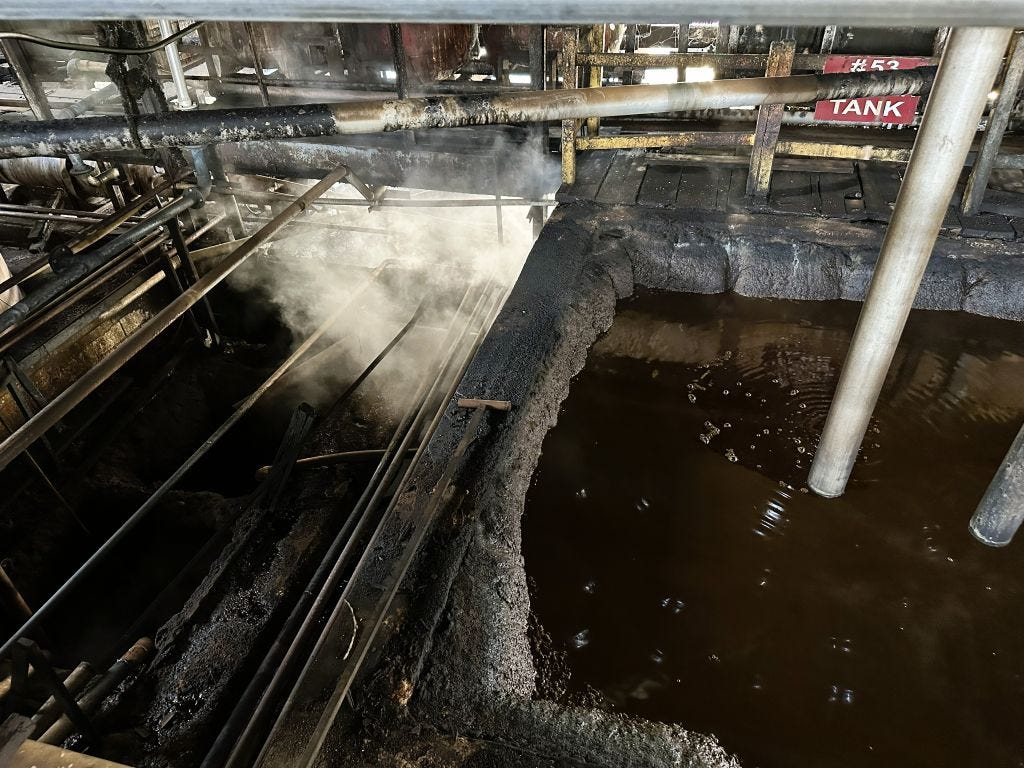
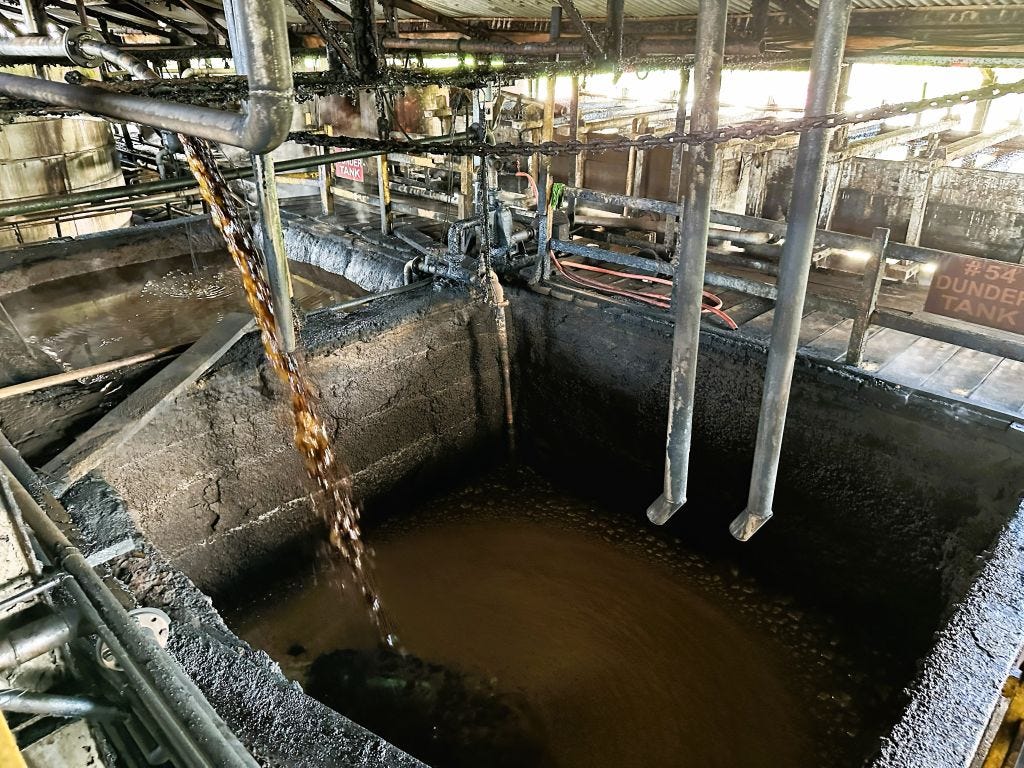
Given that fermented wash is over 90% water before distillation, it’s not surprising that what remains, i.e., dunder, is also mostly water. Also present, albeit in much smaller quantities, are acids, higher alcohols, dead yeast cells, and other assorted molecules.
In rum fermentation, dunder replaces some of the water that would otherwise be used. For instance, if a typical fermentation recipe calls for 1000 gallons of water, you might instead use 500 gallons of water and 500 gallons of dunder. Due to the acids in the dunder, the resulting mash will have a lower pH level than if only water were used. And with more acid molecules available to the yeast, more esters result! The acid in dunder also suppresses lactic bacteria, which produce lactic acid toxic to yeast cells.
Increased acidity isn’t the only benefit of dunder. The dead, decomposing yeast cells create nutrients that living yeast cells consume. As I said above, yeast does not live by sugar alone!
Jamaica isn’t unique in its use of dunder/vinasse/stillage. French rum makers in Martinique and Réunion use it to make grand arôme rums. And American sour mash bourbon? They’re also using dunder, although they’re more likely to call it stillage. Either way, they’re acidifying the fermentation using the waste liquid from prior distillations.
The word “dunder” is primarily used in a Caribbean context. Stillage and spent lees are common English language terms for it. Scotch whisky distillers call it pot ale. French-speaking cultures call it vinasse, and French rum makers use vinasse in the production of grand arôme.
Cane Acid
The other primary way of acidifying a yeast-driven fermentation goes by the somewhat concerning names of acid or cane acid. Rest assured, cane acid isn’t some industrially produced chemical compound. Rather, think of it as homespun sugarcane vinegar made on a larger scale—thousands of gallons at a time.
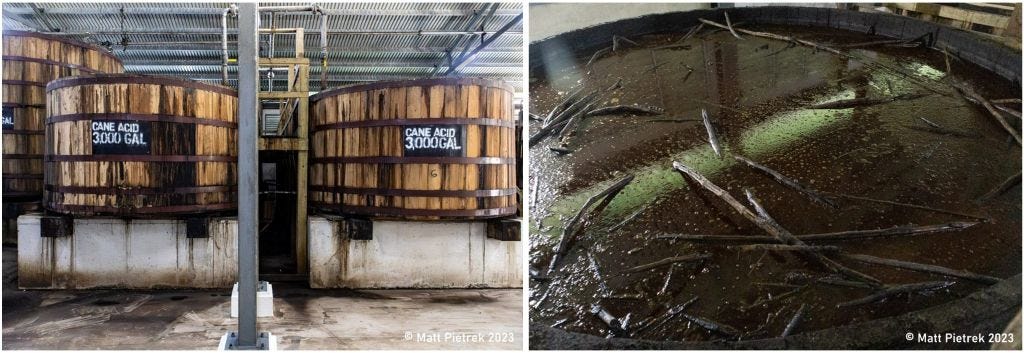
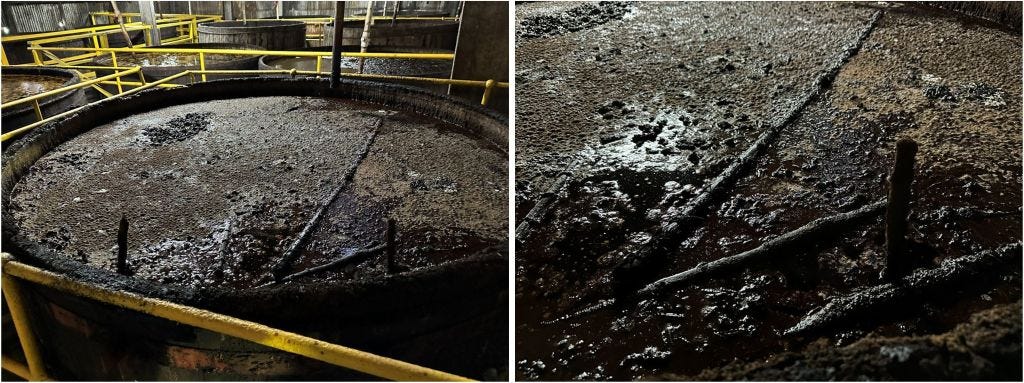
Cane acid starts as fresh-pressed sugarcane juice in a vat, along with cane trash, i.e., cane stalk remnants. Wild yeast cells living on the cane stalks initiate a fermentation process somewhat similar to that of a rhum agricole. But rather than distilling this liquid after fermentation finishes, it continues to sit. Eventually, ambient bacteria of the species Acetobacter aceti start consuming the ethanol and emitting acetic acid.
To recap:
1) Sugar + yeast —> ethanol + congeners
2) Ethanol + bacteria (Acetobacter aceti) —> acetic acid
This two-step process isn’t unique to rum making. The distilled white cane vinegar you buy at the grocery store follows the same basic process, although in far more sterile conditions.
As with dunder, cane acid replaces an equivalent amount of water that would ordinarily be used in the mash. But unlike grocery store cane vinegar, which contains just water and acetic acid, the cane acid that Jamaica’s distilleries make also contributes wild yeast strains and pre-formed esters to the mash.
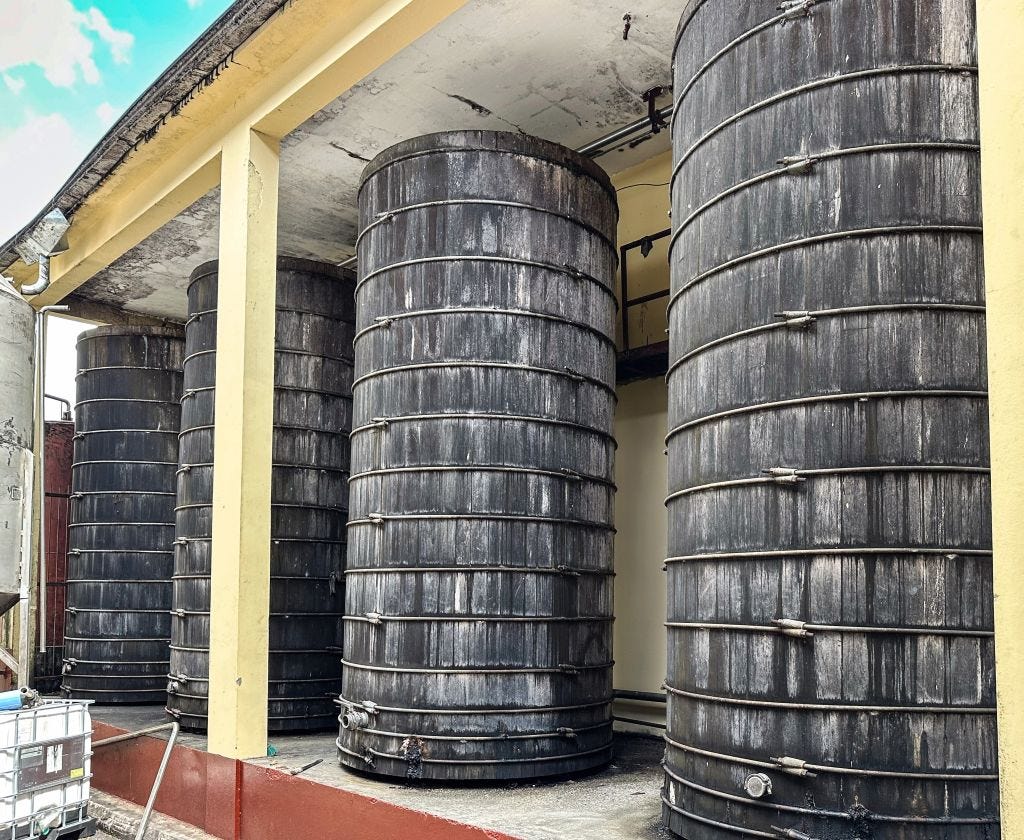
The above explanation of cane acid was intentionally simplified. A more detailed description is provided by Charles Allan of the Jamaica Sugar Experiment Station, who wrote in 1905:
Acid is made by fermenting rum cane juice, which has been warmed in the coppers. To this juice is added dunder and sometimes a little skimmings. When fermentation is about over the fermented liquor is pumped on to cane trash in cisterns and here it gets sour. Into these cisterns sludge settling from the fermented wash is from time to time put. This acid when considered fit for use smells like sour beer.
Source: Report on the Manufacture of Jamaica Rum by Charles Allan, B.Sc., Fermentation Chemist.
Part Two Wrap Up
Dunder and cane acid are both techniques to acidify a rum mash, which causes the yeast to emit more esters and, to a lesser extent, a different mix of esters and other congeners. Dunder and cane acid can be used individually or together in fermentations. Typically, high-congener fermentations use pombe yeast because it survives better than cerevisiae at lower pH (higher acidity).
Thus far in this series, I’ve focused on yeast-centric fermentation. However, there’s another path that produces the more complex acids and esters that are emblematic of high-congener rums. In part 3, we’ll take a turn towards the dark side — another organism that supports fermentation, yet is shunned by most distillers.

Great stuff Matt, I wonder which rabbit hole comes next Geotrichum? I look forward to it.
Matt, do you have any info on what happens to the cane trash before it is put into the cisterns for fermenting cane acid, and after this fermentation? Is this trash loaded fresh each time, or is it the same batch for the entire season?