


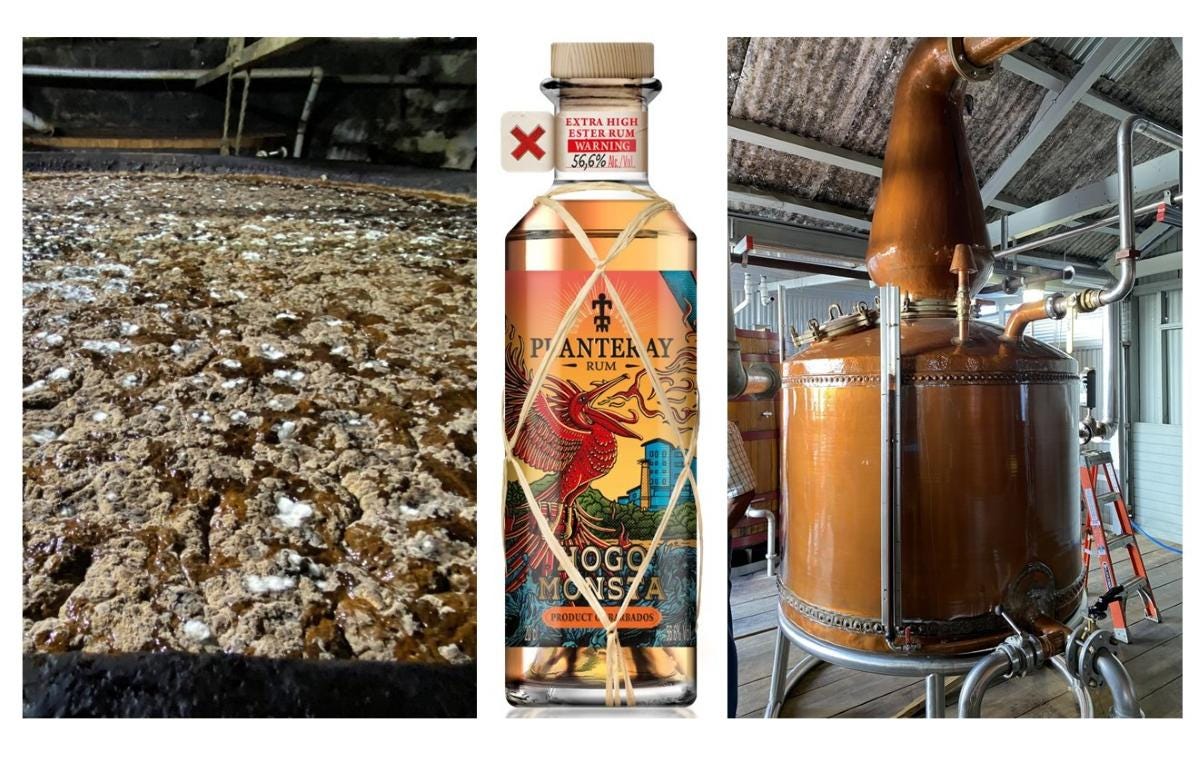
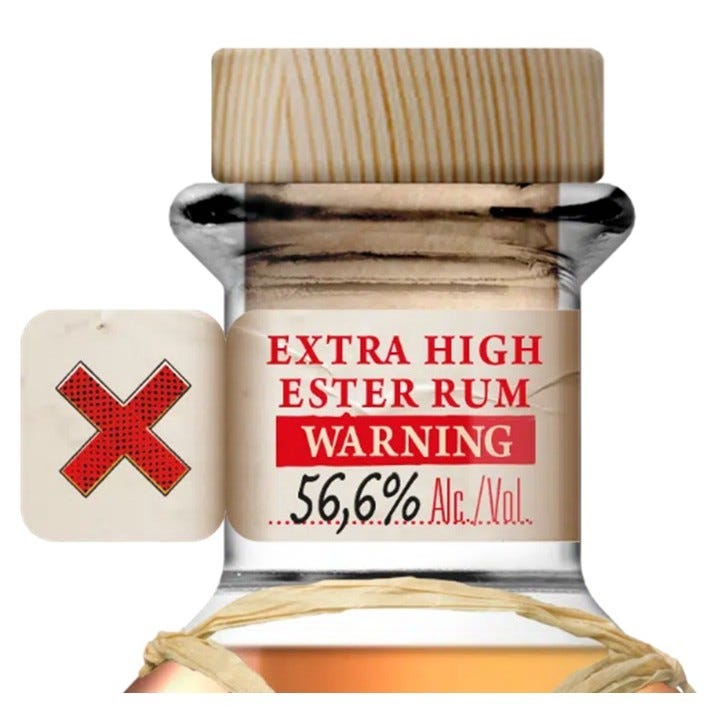
In a recent Maison Ferrand post about Planteray’s Hogo Monsta rum, Alexandre Gabriel is quoted: “Don’t buy it if you don’t know what it is!” Why would a company say that? The short answer is that this rum is very different than what the company’s customers are used to. Let’s dig into what makes Hogo Monsta so different.
There are many ways to classify rums, most of which have severe flaws. But if we were to classify using flavor intensity as the only criterion, there are two groups:
Rums intended for people to enjoy consuming
Rums intended as high-intensity flavor concentrate
The first type comprises well over 99% of the rum made – rum you’d find in a liquor store or a bar. Pour it into a glass and drink it.
The second type is essentially a flavor extract, much like vanilla extract for baking. A few drops add a ton of flavor wherever they’re used. Would you pour an ounce or two of vanilla extract into a Glencairn glass to enjoy by the fire? Probably not. The flavor overwhelms.
A more apt example for the cocktail crowd is Angostura Bitters, typically used a dash or two at a time. Just the thought of drinking two ounces of Angostura bitters would turn most folks pale. Hogo Monsta and its siblings are essentially “rum bitters.”
I’m legally mandated to point out that some folks enjoy consuming large quantities of Angostura bitters in cocktails; myself included. I wrote about these extreme drinks on my Cocktail Wonk site: Can You (Ever) Use Too Much Angostura Bitters?
Rum traders and blenders have used these rum bitters for over 150 years. But until the early 2000s, even hardcore rum enthusiasts didn’t know about these rums and had no way to buy them. But as the rum enthusiast movement began accelerating around 2010, knowledge of these extreme rums spread. Slowly at first, rum geeks could buy a bottle of Hampden DOK or Grand Arôme from indie bottlers like Velier and others. A decade later, there’s a cornucopia of high-congener rums available. Not only can you buy Hampden DOK, but you have a choice of age and cask finishes!
Jamaica, Martinique and Reunion are the primary locales known for making high congener rums. Think distilleries like Hampden, Long Pond, Le Galion, and Savanna. But Barbados, practically synonymous with exceptionally aged and blended rum, has never been a hotbed of extreme, high-congener rum making – until this current decade.
Foursquare, with its LFT (Long Fermentation Type) rum released in 2022, was the first Barbadian distillery to make waves in this area. But at 555 gr/hlAA, its esters are lower than those found in grand arômes, and about a third of the 1600 gr/hlAA found in Hampden DOK and Long Pond TECC.
It was WIRD that fully brought Barbados rum making into the heavyweight ester category with its Hogo Monsta releases. With an ester level over 2000 gr/hlAA, it may have the highest ester level of any rum sold directly to consumers today. Read on to see how this ester level was created.
While “high ester” is the de facto geek terminology for these extreme rums, esters are only part of the flavor story. Scientific measurements show esters are rarely the primary type of flavor compounds present in most rums, even in rums considered high in flavor. A better name for such rums is “high congener.” Congeners include more flavor compounds in the measurement. See this story for more detail.

Circling the Monster
When I saw the Hogo Monsta announcement, I knew a deeper look here was essential. Based on my then-current knowledge of high-congener rum making, I gave Planteray’s technical team a detailed set of technical questions. The answers surprised me and sent me back to the woodshed to further improve my understanding of esoteric fermentation chemistry. I shared what I learned in a four-part series. “Making Funky, High Ester Rum.”

Until recently, WIRD was best known for making light column-distilled rum for the Malibu brand. But since becoming part of Plantation/Planteray in 2017, pot stills and long fermentation have taken center stage. There’s now a dedicated batch distillation area with four stills and wooden fermenters for making heavy rums. And because of a partnership with the Barbados Sugar Cane Breeding Station, and WIRD’s acquisition of Kendall Farm, the distillery can choose between Barbados molasses and cane juice as fermentation substrates.
Note: In what follows, I’m discussing a bottling of Hogo Monsta released in October 2025. More batches may be coming.
Inside Hogo Monsta
Fermentation is the origin of a rum’s flavor. Most rum made today, especially Spanish heritage style, uses a fermentation protocol that prioritizes ethanol over flavor molecules. But high-congener, high-flavor rums require a very different type of fermentation.
Most rum fermentations utilize S. cerevisiae yeast, while more exotic ferments typically use S. pombe yeast. When stressed by low-pH environments, pombe creates flavors that distinguish funky Jamaican (and similar) rums from more mainstream rum flavors. I covered this in part two of my series.
You might think of cerevisiae as the well-behaved and studious kid who gets A grades in school through their hard work, while pombe yeast is the slacker that makes things interesting. (Think Judd Nelson in The Breakfast Club).
But using pombe yeast can only take flavor creation so far. To get the truly weird flavors like ultra-funky Jamaican rums have, bacteria need to crash the party. Bacteria don’t care about turning sugar molecules into ethanol. They’d rather make horrific-smelling acids: vomit, body odor, and worse. But in a twist of organic chemistry, those acids combine with the pombe-created higher alcohols to make the class of esters associated with high-congener rums. In other words, you can’t go superfunk without leaving the mainstream.
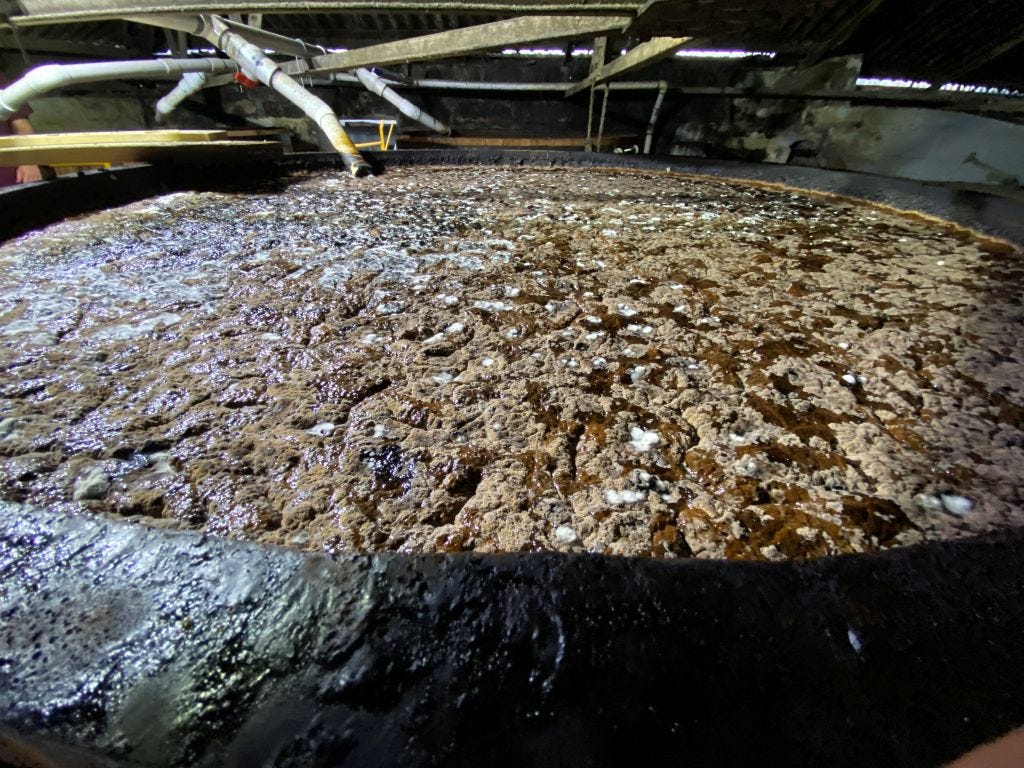
WIRD’s “nursery” is the ultimate party pad for starting funky ferments. It’s essentially an above-ground swimming pool holding thousands of gallons of wild yeast and bacteria. The liquid starts with cooled pot still dunder. Naturally occurring yeast and bacteria soon settle on it and start propagating. The nursery is analogous to a sourdough yeast starter in a home kitchen; small amounts are taken out over time, but adding new nutrients keeps the ecosystem alive.
To make Hogo Monsta, Barbados molasses is diluted to 16 brix before adding liquid from the nursery. The mash ratio is 85% diluted molasses to 15% nursery liquid. The mash then goes into cedar and oak fermenters, where it bubbles away for about two weeks. Afterward, cane vinegar and dunder are added to the fermenter to increase medium- and long-chain ester creation. (Note: a cane juice version of Hogo Monsta has also been made, but not released as of this writing.)
When the two-to-three-week ferment completes, the wash is between 3% and 5% ABV, less than half of many mainstream rum ferments. And unlike typical fermentations, WIRD’s wooden fermenters aren’t fully emptied and cleaned after each batch. Instead, part of the ferment wash remains in the fermenter to help start the next batch. You might think of it as a “fermentation solera,” as each batch contains portions from prior fermentations.
Hacking Ester Creation
Distillation of the congener-heavy wash is a three-pass affair; there are no retorts at WIRD like in Jamaica’s distilleries. The John Dore “88” or the recently renovated “Rockley” stills handle the initial distillation duties. The 88 still (previously called the Hot Pot) is 2,000 liters and was installed in 2020. The Rockley still, built in the late 1700s, was recently renovated in France and returned to active duty.
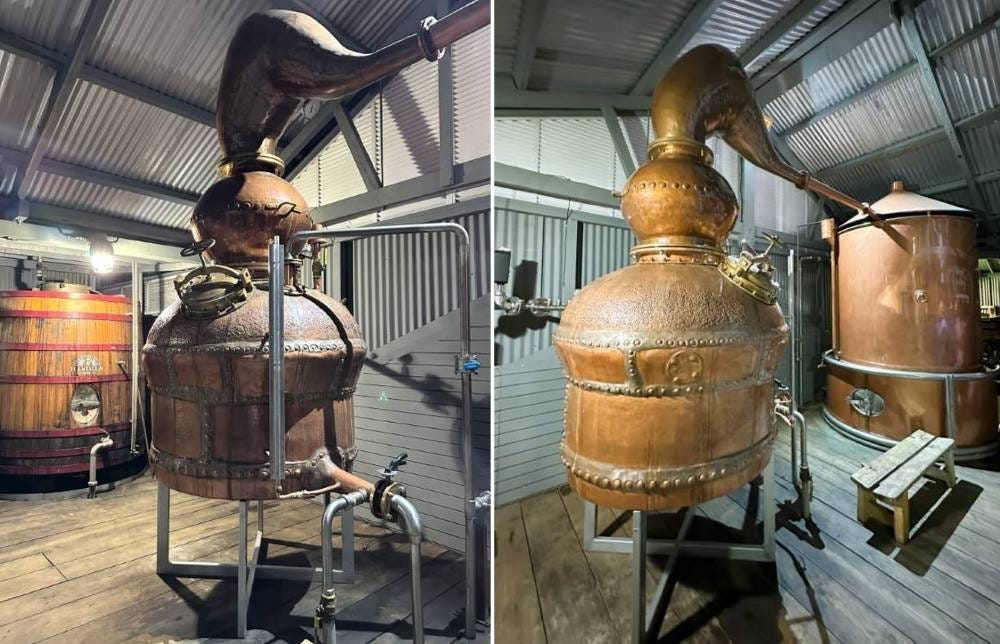
The first distillation creates “low wines” at around 20% ABV, while a second distillation yields “high wines” between 50% and 55% ABV. Up to this point, nothing in the distillation process is out of the ordinary; what comes next is.
The liquid remaining in the still after the 2nd distillation is called “lees.” Calcium oxide is added to the lees, and the mix is dried in steam pan driers to create “lime salts.” Without getting too deep into the chemistry, the lime salts hold a high quantity of fatty acid molecules, albeit chemically locked up as “salts.”
About a day before the third distillation, the high wines, the lime salts, cane vinegar, and sulfuric acid are combined. Sulfuric acid is necessary to release the fatty acids into the liquid. The liquid is then distilled a third time, yielding rum at 85% ABV.
Why this extra step with lime salts and acid? In part 4 of my series, I covered the work of H.H. Cousins, Jamaica’s island chemist. In 1906, he patented a process for creating extremely high ester levels in the 2nd (“high wine”) retort, which then pass into the distillate.
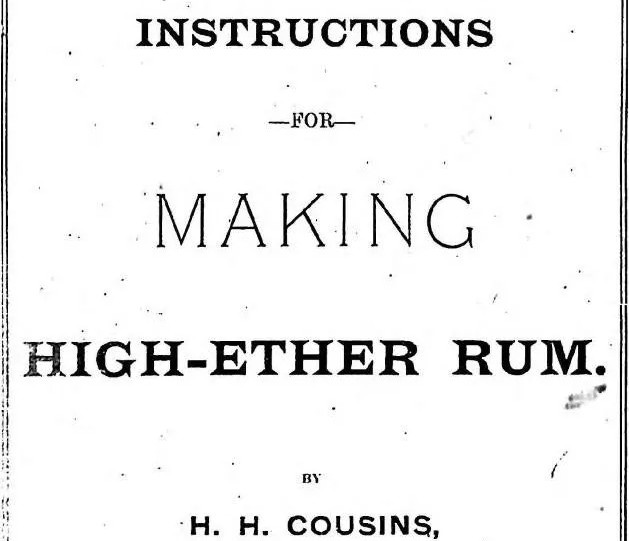
Cousins noted that the 2nd retort naturally has two of the three optimal conditions for creating esters: high heat and high alcohol levels. The third required condition is high acidity, with the right type of fatty acids. Cousins’ technique obtained these acids from the high-wine retort lees, temporarily locking them up as lime salts, then unlocking them later with sulfuric acid. Does any of this sound familiar?
Cousins reported making rums with ester levels of 6000 gr/hlAA, about 5x higher than otherwise possible. While Hogo Monsta’s ester and volatile compound levels (2029 and 3178 gr/hlAA, respectively) don’t reach the same levels that Cousins reported, they’re still significantly higher than current Jamaican law allows. Since 1935, the ester level of Jamaican rum has been capped at 1600 gr/hlAA. (The distilleries can actually go significantly higher, but they can’t sell it as rum.)
Before bottling, this batch of Hogo Monsta aged for a few months in ex-bourbon casks in Barbados and was diluted to 56.6% ABV.
Final Thoughts
You’re naturally wondering what this batch of Hogo Monsta tastes like. As you’d expect, the aroma leaps from the bottle. Mrs. Wonk noticed it from the other side of the room. Many high-congener rums have an aroma that I can best describe as hard strawberry candy dissolved in vinegar. Hogo Monsta is no exception.
Taste-wise, it reminds me of a “brighter” version of Long Pond STC♥E and TECC. Tons of fruit but much less of the oily, bottom-end heft that continental-style Jamaicans have in spades. While I have no trouble sipping this, I’m more likely to use it a drop or two at a time in a rum cocktail to create my own rum blend à la minute.
Today’s rum enthusiasts are fortunate to have access to many rums once exclusively sold to blenders for blending. But it’s rarely the brand/distillery making these rums that sells them to consumers. With a few notable exceptions, it’s usually the independent bottlers selling the crazy rums not intended for civilian drinkers.
It may be that the brands behind the distilleries don’t want to confuse their existing customers with something so wildly different than the usual expressions they sell. So, I say kudos to the “original producer” brands willing to sell their extreme rums directly. Savanna is a great example with its Lontan and HERR expressions. With Hogo Monsta, Planteray joins the club.
Editorial disclosure: Alexandre Gabriel and I co-authored a book, The Rum Never Sets, which was commissioned by Planteray.
Rum Wonk is free to for all, but you can help support my independent journalism by buying books from Wonk Press, my publishing company.
